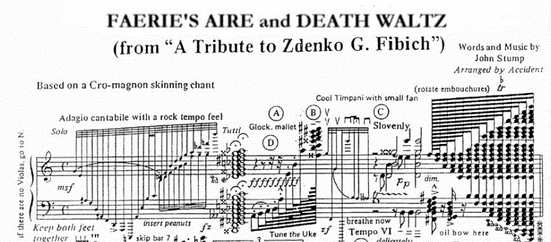
 An excerpt from a piece by the great John Stump that I like to call, "Uhhhh..." An excerpt from a piece by the great John Stump that I like to call, "Uhhhh..." As a performing musician, I sometimes get asked a difficult question -- how did you become proficient on your instrument? The obvious answer would be: practice, lots of practice. And of course that is suitable advice to give to anybody who is looking to learn something that is as technically demanding as playing the guitar. I am aware that we each have a unique capacity for learning new things, however simply telling a prospective guitar player to practice scales, always use a metronome, and always play for at least an hour may not always be the best advise. My point is this: establishing rigid practice habits is fine, but if I had a nickel for every hour I spent just holding a guitar and "noodling" I would have at least a month's worth of rent (and that's saying something in Santa Cruz!!!). Allow yourself the time to become familiar with your instrument on a more subconscious level (open-tunings lend themselves well to this approach) and "practice" using your intuition and judgment as well as your metronome and chord charts. For me, music is something that exists in the head AND the heart, and I would urge anyone who is looking to pick up the guitar or ukulele or banjo or tuba to simply exercise the habit of being with or near your instrument...always. Have it around and accessible, and remember this cheesy adage: practice makes perfect, but playing makes you happy--just ask Allen Iverson! Until next time! -McCoy
0 Comments
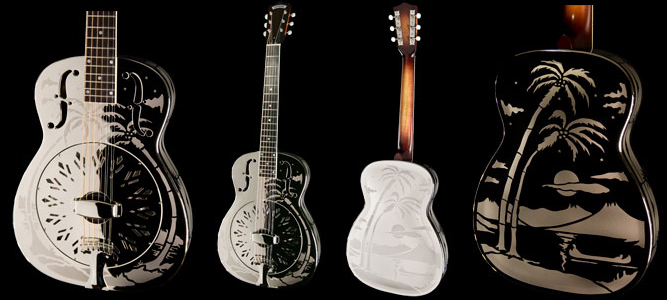 The National ResPhonic Style 'O' Guitar 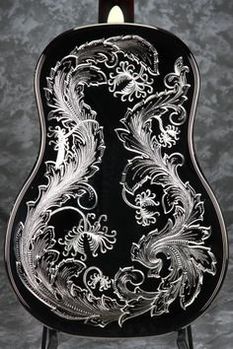 Intricate hand engraved design on the back of a modern National ResoPhonic Tri-cone Guitar Intricate hand engraved design on the back of a modern National ResoPhonic Tri-cone Guitar Once in a while someone will come in our shop and say "hey, why does that guitar have a hubcap on its face?" The first answer is usually "Well sir, that is actually a car, not a guitar, and you might consider updating your prescription lenses." Once the cavalcade of ensuing laughter subsides, we give the real answer which is, as you might have guessed, "why, that's a resophonic guitar!' Invented in the late 1920's to compete with loud banjos and brass instruments, resophonic guitars use an internal aluminum speaker cone to 'amplify' the sound of the guitar. The strings sit on the bridge/saddle which either sits directly on the cone, or on a 'spider' mechanism which in turn rests on the cone. The vibration of the strings causes the cone to flex, just like a speaker cone, and the resulting sound is a louder, more metallic tone than a standard acoustic guitar. There are also 'tri-cone' versions that use three small cones as opposed to one large cone. The tone on these is not quite as loud, but a bit more defined and articulate. National was the first company to bring these to market in 1928 and they soon offered a wide array of models in both single and tri-cone. They made 'Spanish' guitars, tenor & plectrum guitars, 'squareneck' guitars, mandolins, and ukuleles and many of their instruments were adorned with beautiful hand engraved scenes and motifs. Today, National ResoPhonic Guitars in San Luis Obispo carries on the tradition. They manufacture spot-on re-creations of the original National guitars as well as several of their own modern designs and models. Their guitars sound and play as good as the old ones but are even more durable and road worthy, and have modern updates like better tuning gears and truss rods in the neck. Whether you're a beginner or a long time player, if you haven't played a resophonic guitar, you owe it to yourself to try one. So come play a hubcap guitar, it's guaranteed to get your musical wheels spinning! -Mike
Well, it being Mother's Day, and since I blog now, and this is "Blog," I can think of nothing better to 'blogabout' than my mom. Her name is Kathryn and she is fierce and brave. There was this one time she aggressively swore at a group of teenagers because they laughed when some ice cream I was eating fell to the ground. They looked like total jerks, and I understood then what it was to be guarded by a lioness. This ferocity is but one facet of a greater vigilance in my mom; her staunch support for social justice and the strength and grace with which she carries herself lend me the courage to keep my own proverbial fire burning. Also, being a snotty 27 year old, I find myself pompous and overtly proud when I realize my mom is a Generation X-er whose social politics and taste in music are still relevant and evolving. Mom, you are really cool and I love you for that. She also happens to be one of the few members of my family who can carry a damn tune and while this may or may not be attributable to genetics, in the case that it is, I have her to thank for my predilection toward the noisier art. Thanks also for the garage mom, if I didn't have the escape of that room, if I wasn't afforded the space to blast my ears with amps while lying on the floor feeling depressed, I don't know how I would've turned out. God, she even still comes to my shows. At a DIY punk space in the middle of La Puente, I'm playing music with friends that is generally, too loud, angry, and misanthropic, but there she is, just to my left, bobbin her head with several punk kids at least half her age. Did I mention how cool my mom is? I could espouse cool-mom anecdotes all day, but really the point I'm trying to make is love. Mom, I'm very thankful to have had someone like you growing up, you've never not been there, and even if we now live in different cities 8 hours apart, you're never far from my thoughts. I love you so much. -Alex
 I've been asked countless times by prospective customers whether or not a instrument is easy to learn. I know it may seem like a simple straight forward question, but its more difficult to answer than you think. The short answer is no, it isn't easy, otherwise everyone would know how to do it. Regardless of what instrument you decide to play, there is a certain level of commitment that comes with it. Some instruments, like bass guitar and ukulele, have a shallower learning curve to begin with, while guitar requires a little more effort up front. In the end, however, it takes just as much fortitude to be proficient in any instrument, as long as you still have the passion. As much as we would love to have them, no guitar we sell comes with talent. We try our hardest to match you with the right instrument, as to increase the likelihood that you will continue to play it. We also offer lessons from skilled teachers to help you on your journey, but ultimately, whether or not something is easy depends on you.
What’s “High Strung” or “Nashville” tuning? You hear it on songs like Pink Floyd’s “Hey You”, “Dust in the Wind” by Kansas, and the Stones’ “Wild Horses”, not to mention countless others. Specifically, High Strung/Nashville tuning uses standard 1st and 2nd strings, and one octave higher on the 3rd, 4th, 5th, and 6th strings. Strings 3 through 6 are actually the ‘octave strings’ from a 12-string set. High quality string manufacturers like D’Addario make dedicated High Strung/Nashville string sets. You can purchase individual strings as well. Typical gauges (high to low) are: .010 .014 .009 .012 .018 .027 High Strung or Nashville tuning is most frequently heard on acoustic guitars and is commonly used to “double” a standard-tuned acoustic. Strung in this manner, a guitar takes on an entirely different character. It sounds bright and almost piano-like. Capo up at the fifth fret and the guitar begins to sound like a harpsichord. At about $5 a set, High Strung tuning is the simplest and lowest–cost change you can do to enable your acoustic guitar to sound like a very interesting and entirely different instrument. Give it a try. - David 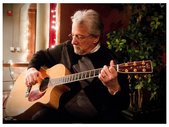 David Robin got his start in the 1960's Chicago rock n' roll scene and has built up an impressive, lengthy musical resume in the years since. After all these years, his love of the guitar is as strong as ever.
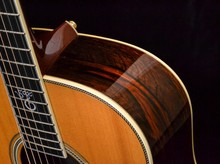 Santa Cruz Guitar Co. Tony Rice Pro with Brazilian Rosewood Back & Sides Santa Cruz Guitar Co. Tony Rice Pro with Brazilian Rosewood Back & Sides Last week I touched on the importance of EQ with regards to getting a natural sounding acoustic tone from your amp or DI box. I would like to delve a bit further into that topic this week and discuss how we can think about EQ relative to the instruments themselves. Tonewoods on an acoustic guitar dictate the overall responsiveness of certain frequencies that are produced when the instrument is strummed or picked. As an example, our 1958 Martin D-28 has Brazilian Rosewood back and sides, which generally have a "scooped midrange" type sound, meaning the lows and highs are more pronounced and the middle frequencies less so. This type of response can compliment a singer very well, as the guitar's natural "smiley face" EQ curve leaves room within the mix for the voice which, for most of us, happens to be naturally mid-rangy. Conversely, mahogany tends to be more mid-rangy, with the lows and highs falling off a bit--a "frowny face" if you will. Our 1937 D-18, for example, has a big robust sound that would do well in a bluegrass jam or acoustic ensemble because the abundant mids allow the guitar's voice to cut through in the mix. (Check out the video below of Tony Rice and Norman Blake--see if you can hear the difference between the 14-fret D-28 with Brazilian Rosewood that Tony is playing and the 12-fret D-18 with Mahogany that Norman is playing!) These days, there are a plethora of different tonewoods available--yet another factor to consider when making your next guitar purchase. Stop by the shop sometime and try a few out! -McCoy  McCoy Tyler is a salesman at Sylvan Music with an aptitude towards acoustic guitars, amps, and pickup systems. When he's not spouting musical knowledge on the sales floor, he can be found doing some hot picking and sweet singing with his group The McCoy Tyler Band.
 When was the last time you went to see live music? If your answer is not at least "sometime in the last few months" then you are doing yourself and the musical community a disservice. And you deserve a paddlin'! There is so much good music being played right now and odds are there's even some happening in your town..... tonight! Not only is it soothing for the soul, but it's increasingly becoming the best way to directly (financially) support music and musicians you like. AND, you can can look at it as a lesson as well as entertainment. I've learned so much just from watching musicians up close at concerts. Technique, chord shapes and changes, and gear choices are usually very easy to gleam from a musician at a concert, assuming it's not a huge venue. And on that point, the smaller the venue, the better. It's very hard to connect with a band in a stadium, especially if you're not in the first 30 rows. In closing, get out there and see some gosh-dang live music! Tonight!! -Mike
Man, you know what really grinds my gears? Merriam Webster's definition for harmony: "the combination of different musical notes played or sung at the same time to produce a pleasing sound" First half we're doin' alright, different notes, same time. Yes, I am on board. However, I take issue with the concept of "pleasure" being included in this definition. I very specifically enjoy harmony others (of perhaps less refined palettes) might find displeasing. Maybe it makes them cringe in their seat a little, maybe there isn't that safe cadential figure leading back to "one." Guess what friends, there is no "one." Western music theory and harmony, and everything we listen to in this tradition, while a very neat and impressive collection of rules and ideas concerning organization of sound, is totally arbitrary. One may contend that the overtones in the harmonic series (those perfect 5ths and 3rds) are why we hear certain combinations of notes and sounds and we be like, "oh hey that sounds nice, what sweet pleasing sound." But naw dawg! The early Christian church (from which pretty much all contemporary music theory is derived) just had to control everything and codify things into rules, because God loves rules. So that really "dissonant" harmony, the one where there's two notes separated by six semitones, we're gonna call that "diabolus in musica," and you are NOT allowed to play it because it is so ugly and gross. Well, fortunately musicians quickly determined that the church was a goofball, and the "tension" present in this harmony (commonly referred to as the tritone) was resolvable, and as such could reflect the ebb and flow of life, like an exhale after holding your breath for too long, it could become something expressive. And it's true, to the Western ear, hearing an F against a B resolve into a C and E, sounds pretty satisfying, but also... saccharine. Why does that tritone have to resolve? Why can't it just hang out there and sound nice, be fine on its own, I think it sounds nice. Here are some of my favorite pieces of music that dare to subvert these Western traditions, as well as some resources if you're curious about some of the subjects mentioned: http://en.wikipedia.org/wiki/Overtone http://en.wikipedia.org/wiki/Tritone http://en.wikipedia.org/wiki/Atonality Schoenberg was a German composer from the Late Romantic period and began composing in that tradition before switching gears entirely, and inventing his own serialized approach to harmony organization. This piece predates his more organized 12-tone serialism, but it does a pretty beautiful job of ignoring a tonal center while remaining particularly Romantic in its expressivity and dynamics. Portal is a death metal band hailing from Australia. While this piece of music has trace elements of tonality, particularly around a minute and a half in, there is a very purveying sense of dissonance and atonality. The deliberateness in which they do not pander to Western tonality I find both hauntingly beautiful and terrifying. Also the video. Honestly I should've put this first. Ornette Coleman, and all pioneering Jazz musicians, were immediately pushing harmonic boundaries (all boundaries for that matter). This is an example of "free jazz," a musical movement with which Coleman was strongly associated. I will not begin to try to explain "free jazz" beyond mentioning that it is rooted far more in independent improvisatory melodic lines, but the resulting harmonies as we can hear in this piece are supreme. That poor lonely woman tho :(
|



 RSS Feed